
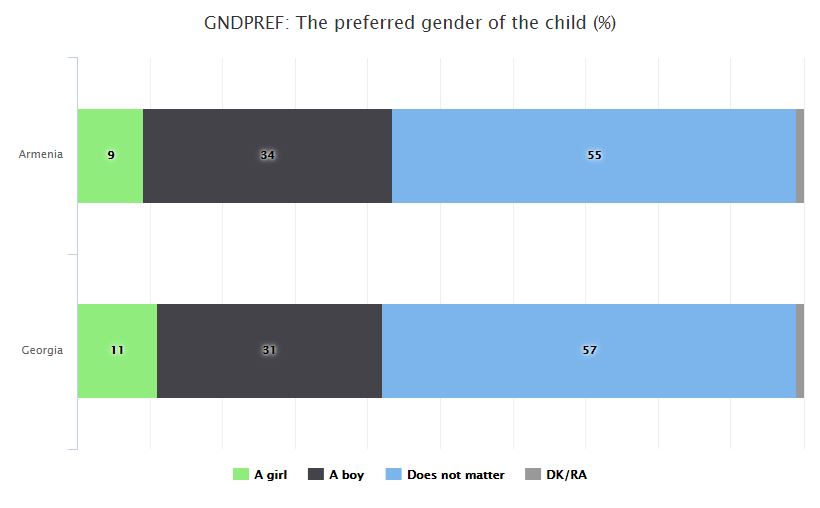
According to the 2010 Caucasus Barometer survey conducted by the Caucasus Research Resource Center-Armenia Foundation (CRRC-Armenia), to the question about the sex preference of the child 54% of respondents answered mentioning a boy, 10% a girl, and 35% said that gender would not matter to them.
According to the same Caucasus Barometer survey conducted in 2020, 9% of respondents answered girls, and the number of those preferring a boy child decreased to 34%, while the number of respondents who did not express any preference increased to 55%.
The fact that the sex of the child is no longer important for more than half of Armenians is encouraging for the current and former UN Population Fund staff, their partner professionals and organizations and all those who can rightfully consider such a change in public opinion as the result of their fight against selective abortions.
For comparison, the indicators in neighboring Georgia are a bit better. 11% of the respondents preferred girls, 31% – boys, and 57% said that gender would not matter to them. 10 years ago, in Georgia the respondents answered the same question like this: 9% – a girl, 46% – a boy, 44% – it does not matter.
In the case of Azerbaijan, only 2010 survey results are available, and it states that 64% of the respondents did not have any gender preference for their children.
Who is the breadwinner of the family? “Equally” progress
It turns out that positive changes are observed not only in the gender preference of children, but also in other issues related to equality between women and men. For example, another change in public opinion concerns the notion of a breadwinner. The entrenched stereotype that the man is the breadwinner of the family is slowly changing in favor of “women and men equally are breadwinners”.
In Armenia, 53% of respondents consider the breadwinner is the man, 16% is the woman, and 28% are for both women and men to support the family equally. For comparison, in 2010 only 17% of respondents chose the equal option.
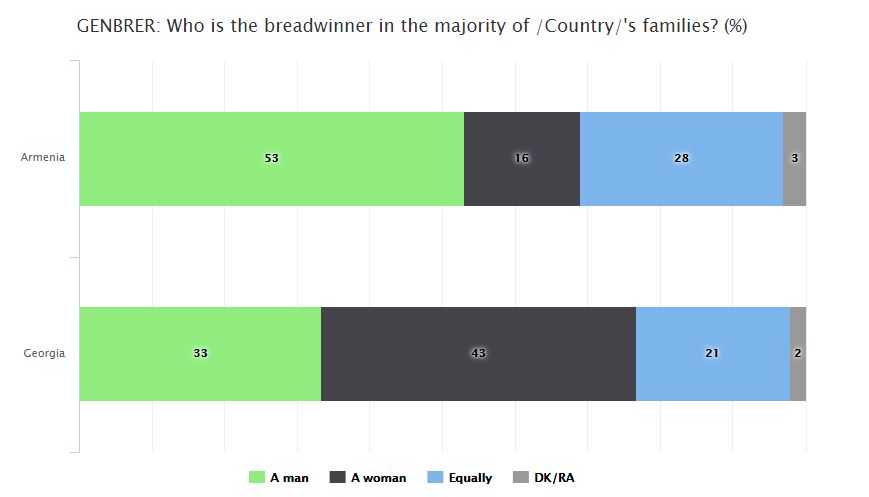
It is noteworthy that 21% of respondents in neighboring Georgia believe that women and men are considered equal to earn for family. In the last ten years, that index has not almost changed: in 2010, 20% answered the same way.
To the similar question who must be the breadwinner of the family 39% answered equally both men and women, 60% – men, 0% – women. Compared to 2010, the progress is obvious. 10 years ago, only 14% answered both men and women must equally be the breadwinners. In Georgia, 34% have chosen the “equally” option, 10 years ago only 14% of respondents were for this option. In Azerbaijan only the 17% were for the equality in this question.
Who should inherit the apartment?
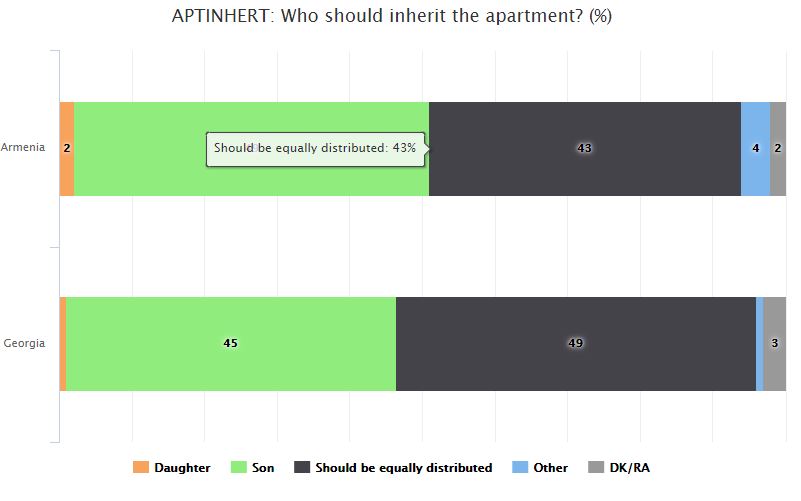
In Armenia, by tradition, it was assumed that the apartment was inherited by the youngest son of the family. As a result of these entrenched practices, daughters are not usually considered as heirs.
However, according to the results of the published survey, this tradition is not as strong in Armenia as it seems. In response to the question about who should inherit the apartment, 43% of the participants answered that both daughters and sons are equal to be heirs and the apartment should be equally distributed. There was no such question in the questionnaire 10 years ago, hence no comparison can be made in this respect.
It should be noted that in Georgia 49% of respondents answered the question the same way.
Women are “not allowed” to live separately from their parents yet
66% respondents in Armenia think that women cannot live separately from their parents at any age. Of course, this is a big figure, but given the trend over the last 10 years, the progress is apparent. In 2010, a similar answer to the same question was given by 79% of respondents.
In Georgia the respondents have a more liberal approach to this issue with only 38% of them saying that women cannot live apart from their parents at any age. There is progress here as well, as 10 years ago that index was 56%. Moreover, 50% think that women should live separately from their parents at the age of 18-25, and in 2010 this opinion was shared by 31% of respondents.
The situation is more worrying in Azerbaijan as in 2010, 87% of respondents mentioned that it was unacceptable for a woman to live separately from her parents at any age.
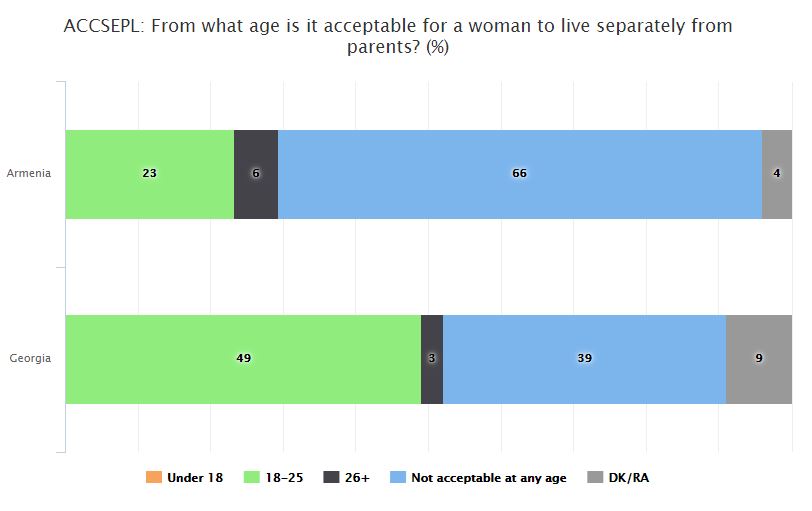
66% respondents in Armenia think that women cannot live separately from their parents at any age. Of course, this is a big figure, but given the trend over the last 10 years, the progress is apparent. In 2010, a similar answer to the same question was given by 79% of respondents.
In Georgia the respondents have a more liberal approach to this issue with only 38% of them saying that women cannot live apart from their parents at any age. There is progress here as well, as 10 years ago that index was 56%. Moreover, 50% think that women should live separately from their parents at the age of 18-25, and in 2010 this opinion was shared by 31% of respondents.
The situation is more worrying in Azerbaijan as in 2010, 87% of respondents mentioned that it was unacceptable for a woman to live separately from her parents at any age.
At what age can a woman get married?
91% of respondents in Armenian and 90% of respondents in Georgia believe that the best age for a woman to get married is 18-25 years old, 2% of respondents in Armenia believe that women should not get married. In Georgia, only 1% believes that women should never get married.
10 years ago, 95% of respondents in Armenia considered that the best age for a woman to get married is 18-25. During the same period, the figure was 94% in Azerbaijan and 92% in Georgia.